| Bookmark Name | Actions |
|---|
Configuration files
Before you deploy Inflow_EE.ear a, make sure that the connection factory, queue connection factory and the queues are created in the application server and the required modifications are done in the configuration files.
Configuration files in Inflow_EE.ear\META-INF
The application.xml file defines the contents of the INFLOW_EE.ear file. The META-INF folder contains application server-specific files too. These configuration files should not be edited.
Configuration files in Inflow_MDB.jar
The application server-specific configuration file need to be edited to provide the JNDI name or the binding name for queue, queue connection factory, data source and the locking data source.
The default queue that InflowMDB is listening to is queue/inflow.
Configurable sections in ejb-jar.xml
The JNDI names for the resources are provided in the application server configuration file.
All the entries below are configurable:
- runtimeProperties
-
This variable is used to set the comma-separated runtime properties for TAFJ session. OFS.SOURCE is the mandatory property and you need to define it in the following way:
<env-entry>
   <description>Comma Separated Runtime Properties for TAFJ Session</description>
   <env-entry-name>runtimeProperties</env-entry-name>
   <env-entry-type>java.lang.String</env-entry-type>
   <env-entry-value>OFS_SOURCE=IFPAOFS</env-entry-value>
</env-entry>
- superTransaction
-
This property is used to configure the transaction boundary. For Inflow, you need to set this property to true.
<env-entry>
   <description>Enable/Disable TAFJ Super Transaction, Disable [false : For Container managed] / Enable [true : For Bean managed] transactions
   </description>
   <env-entry-name>superTransaction</env-entry-name>
   <env-entry-type>java.lang.Boolean</env-entry-type>
   <env-entry-value>true</env-entry-value>
</env-entry>
- healthCheckMode
-
Use this property to set the MDB to run in health check mode. To run the inflow request, you must set this property to false.
<env-entry>
   <description>Health check mode</description>
   <env-entry-name>healthCheckMode</env-entry-name>
   <env-entry-type>java.lang.Boolean</env-entry-type>
   <env-entry-value>false</env-entry-value>
</env-entry>
- userId
-
This property is used to set the Transact user ID to authenticate in both the application server and in Transact. This user should have the PREAUTHENTICATED attribute set and should have all the necessary permissions to run the required inflow in Transact.
<env-entry>
   <description>User ID</description>
   <env-entry-name>userId</env-entry-name>
   <env-entry-type>java.lang.String</env-entry-type>
   <env-entry-value>SSOUSER1</env-entry-value>
</env-entry>
- transactionMode
-
This property is used to set the transaction mode for inflow. The default value is CONTAINER.
<env-entry>
   <description>Provide the Transaction Mode [BEAN or CONTAINER]</description>
   <env-entry-name>transactionMode</env-entry-name>
   <env-entry-type>java.lang.String</env-entry-type>
   <env-entry-value>CONTAINER</env-entry-value>
</env-entry>
Configuration files in Inflow_REST.war
The REST-based web service in inflow reads details about the inflow. All the configuration files in Inflow_Rest.war are available in the WEB-INF directory.
The application server specific configuration file needs to be edited to provide the JNDI name or the binding name for queue, queue connection factory, data source and the locking data source.
springrest-servlet.xml
This is the REST service configuration file that has the information to connect to Transact.
The bean definition with the ID t24DataSource is used to provide the JNDI name of the data source that connects to Transact.
<bean id="t24DataSource" class="org.springframework.jndi.JndiObjectFactoryBean">
   <property name="jndiName">
      <value>jdbc/t24DS</value>
   </property>
   <property name="resourceRef">
      <value>true</value>
   </property>
</bean>
The ban definition with the ID readFlow defines the properties to run requests:
- runtimeProperties
-
This variable is used to set the comma-separated runtime properties for TAFJ sessions. OFS.SOURCE is the mandatory property.
- superTransaction
-
This property is used to configure the transaction boundary. For Inflow, this property is set to false as the purpose of this REST-based web service is to read inflow-related information in Transact.
- healthCheckMode
-
This property specifies whether the MDB is running in health check mode. To run the inflow request, set this property to false.
- userId
-
This property is used to set the Transact user ID that is used to authenticate in application server and in Transact. This user should have the PREAUTHENTICATED attribute set and should have all the necessary permissions to run the required request in Transact.
- transactionMode
-
This property is used to set the transaction mode for inflow. The default value is CONTAINER.
<bean id="readFlow" class="com.temenos.technology.inflow.queue.model.RuntimeProperty" scope="singleton">
   <property name="runtimeProperties">
      <value>OFS_SOURCE=IFPAOFS</value>
   </property>
   <property name="superTransaction">
      <value>false</value>
   </property>
   <property name="healthCheckMode">
      <value>false</value>
   </property>
   <property name="transactionMode">
      <value>CONTAINER</value>
   </property>
   <property name="userId">
      <value>SSOUSER1</value>
   </property>
</bean>
Inflow-EJB.jar
This is the component of inflow that listens for the incoming requests, dispatches the request to Transact for execution, and retries the failed request. In short, it performs all the operations related to executing the inflow request.
The application server specific configuration file needs to be edited to provide the JNDI name or the binding name for the queue, queue connection factory, data source and the locking data source.
The application server configuration files have 3 bean definitions: DispatcherEjb, InflowListenerEjbTimer and InflowFailureRecoveryEjbTimer.
ejb-jar.xml
The EJB bean definition with the name DispatcherEjb is to set the environment entries to execute the inflow request.
The JNDI names for the resources are provided in the application server configuration file.
All the env-entries below are configurable:
- runtimeProperties
-
This variable is used to set the comma-separated runtime properties for TAFJ sessions. OFS.SOURCE is the mandatory property. It is defined as follows:
<env-entry>
   <description>Comma Separated Runtime Properties for TAFJ Session</description>
   <env-entry-name>runtimeProperties</env-entry-name>
   <env-entry-type>java.lang.String</env-entry-type>
   <env-entry-value>OFS_SOURCE=IFPAOFS</env-entry-value>
</env-entry>
- superTransaction
-
This property is used to configure the transaction boundary. For Inflow, set this property to true.
<env-entry>
   <description>Enable/Disable TAFJ Super Transaction, Disable
[false : For Container managed] / Enable [true : For Bean managed] transactions
   </description>
   <env-entry-name>superTransaction</env-entry-name>
   <env-entry-type>java.lang.Boolean</env-entry-type>
   <env-entry-value>true</env-entry-value>
</env-entry>
- healthCheckMode
-
This property specifies whether the MDB is running in health check mode. To run the Inflow request, set this property to false.
<env-entry>
   <description>Health check mode</description>
   <env-entry-name>healthCheckMode</env-entry-name>
   <env-entry-type>java.lang.Boolean</env-entry-type>
   <env-entry-value>false</env-entry-value>
</env-entry>
- userId
-
This property is used to set the Transact user ID that is used to authenticate in application server and in Transact. This user should have the PREAUTHENTICATED attribute set and should have all the necessary permissions to run the required inflow in Transact.
<env-entry>
   <description>User ID</description>
   <env-entry-name>userId</env-entry-name>
   <env-entry-type>java.lang.String</env-entry-type>
   <env-entry-value>SSOUSER1</env-entry-value>
</env-entry>
- transactionMode
-
This property is used to set the transaction mode for Inflow. The default value is CONTAINER.
<env-entry>
   <description>Provide the Transaction Mode [BEAN or CONTAINER]</description>
   <env-entry-name>transactionMode</env-entry-name>
   <env-entry-type>java.lang.String</env-entry-type>
   <env-entry-value>CONTAINER</env-entry-value>
</env-entry>
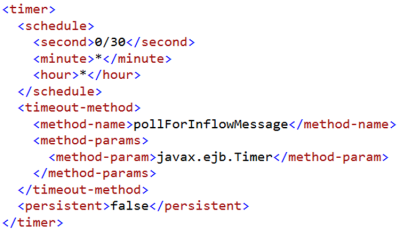
The InflowListenerEjbTimer bean configures the listener which listens for the incoming message.
This has the timer schedule to poll for the incoming message. By default, Listener listens for the incoming posted in the inflow queue message once in 30 seconds:
NOTE:
For information on how to configure the timer, see Using the Timer Service in The Java EE6 Tutorial.
By default, the transaction type is set to bean.
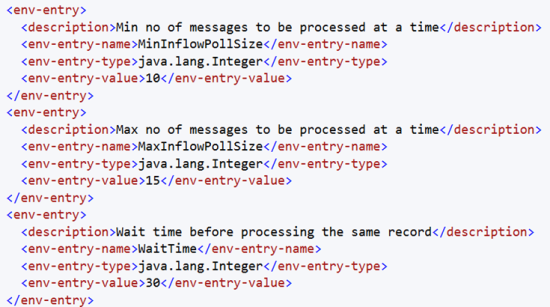
There is a set of environment entries to define the polling properties:
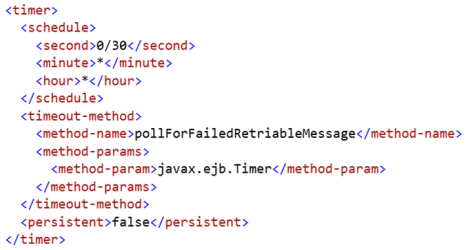
The InflowFailureRecoveryEjbTimer bean is used to configure the options that are used to retry the failed messages.
This InflowFailureRecoveryEjbTimer bean has a timer configuration to poll for failed messages. By default, InflowFailureRecoveryEjbTimer retries a message once in 30 seconds:
By default, the transaction type is set to bean.
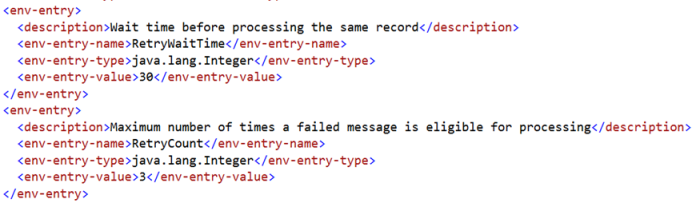
There is a set of environment entries to configure the wait time before retry and retry count:
NOTE:
The users are requested to configure the JNDI names and environment entries other than superTransaction, transactionMode and healthCheckMode. The Inflow package contains preconfigured configuration files.
Add Bookmark
save your best linksView Bookmarks
Visit your best links BACK
BACK


Are you sure you want to log-off?